
The bedtime story: how 10 minutes of reading a day helps your child

The short answer
Reading aloud for about ten minutes a day is one of the simplest ways to grow a young child’s vocabulary, attention and love of books. A 2019 Ohio State University study estimated that children who hear one book a day hear about 290,000 more words by age 5 than children who are never read to.
Key points
- You can start from birth. Babies love your voice long before they understand the words.
- One book a day is about 290,000 more words by age 5.
- Reading the same story again and again is good for learning.
- Talking about the pictures matters as much as reading the text.
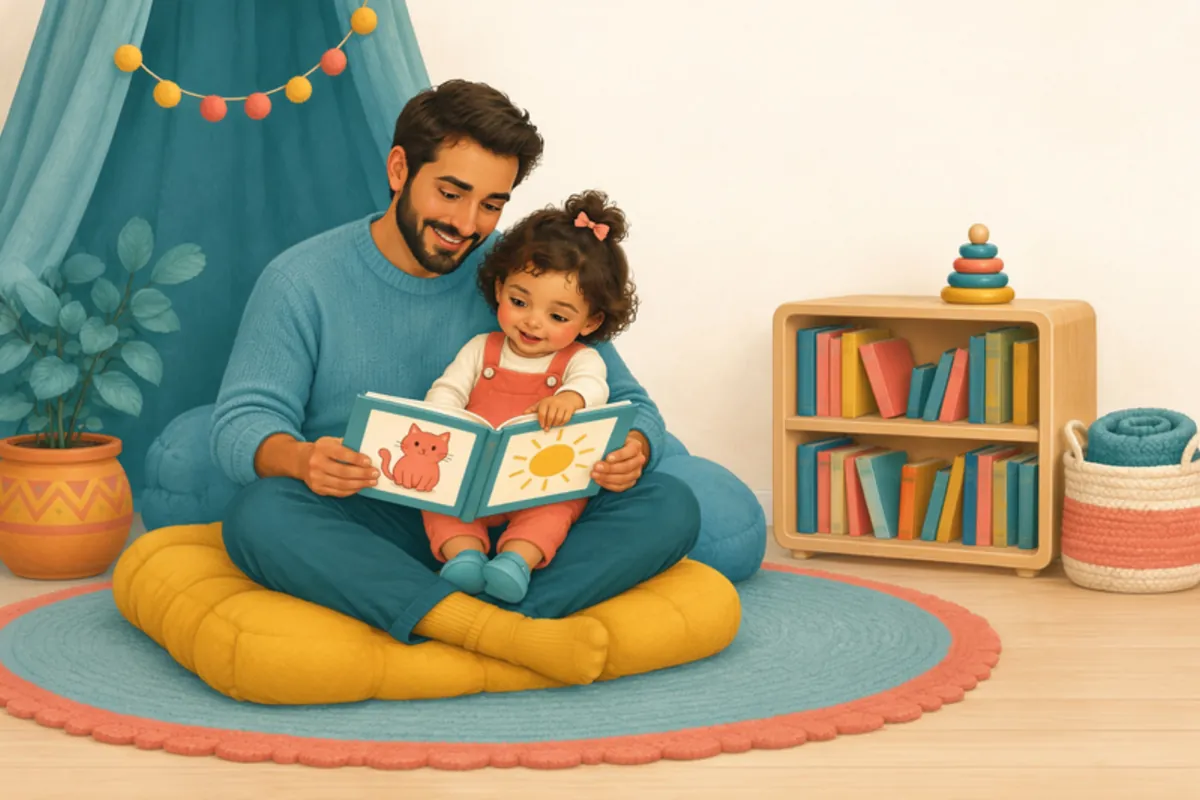
The house is finally quiet. A small body leans on you, a book opens, and for ten minutes the world gets smaller and warmer. The bedtime story is one of the loveliest habits a family can have. It is also one of the most useful.
Why does reading aloud matter?
1.4 million
more words heard by age 5 by children who are read five books a day, compared with children who are never read to.
Researchers at The Ohio State University counted the words in popular children’s books and estimated how many a child hears before school. Even one book a day adds up to about 290,000 more words by age 5.
Why does that matter? Books use words we rarely say in daily talk: “enormous”, “whispered”, “forest”. As lead author Jessica Logan put it, children who hear more words are better prepared to see those words in print when they start school. And beyond words, a story teaches feelings, patience and imagination, in your arms.
What to read, by age
| Age | Good choices | How to read |
|---|---|---|
| 0 to 12 months | Board books with faces, animals and high contrast | Name the pictures. A minute or two is enough. |
| 1 to 3 years | Short books with rhyme, repetition and flaps | Let your child turn the pages and finish the lines. |
| 3 to 5 years | Simple stories with a problem and a happy ending | Ask “what do you think happens next?” |
| 6 years | Longer stories, first chapter books, books about their interests | Take turns: you read a page, your child reads a word or a line. |
9 tips for a story time your child loves
- Same time, same place. After the bath, in bed, with the same lamp. Routine tells the body it is time to slow down.
- Let your child choose. Yes, even the same book for the twentieth time. Repetition is how children learn new words.
- Use your voice. A deep voice for the bear, a tiny one for the mouse. You do not need to be an actor.
- Talk about the pictures. Point, name and ask. For toddlers, the conversation is the story.
- Stop before the end sometimes. “What will the rabbit do?” Guessing builds thinking.
- Link it to real life. “Remember when we saw a cat like this at Teta’s house?”
- Read in Arabic too. Stories are the easiest way for children to hear beautiful Standard Arabic. If a word is hard, explain it in your home dialect.
- Keep books within reach. A low shelf or a basket lets your child pick up a book alone.
- Keep it short on hard days. Two minutes still counts. The habit matters more than the length.
What if we do not have many Arabic books?
Stories do not only live in books. Tell the stories you heard as a child. Make up a story with your child as the hero. Look at family photos and tell what happened that day. Ask grandparents to record a story on the phone. What matters is your voice, your words and your time together.
Questions parents ask
At what age should I start reading to my child?
From birth. Newborns are calmed by a parent’s voice, and babies start to enjoy pictures within their first months. It is never too early and never too late to start.
How long should I read to my child each day?
About ten minutes a day, or one short book, is a good goal. On busy days even two minutes keeps the habit going.
Is it normal for my child to ask for the same story every night?
Yes, and it helps. Hearing a story again and again lets children learn its new words, predict what comes next and feel safe.
Should I read in Arabic or English?
Both, if you can. Read in the language you enjoy reading in, and include Arabic stories regularly so your child hears Standard Arabic early and often.
Sources
These links open other websites, in English.
This article gives general information for families. It does not replace advice from your child’s doctor or another specialist who knows your child.


