
How to teach your child the Arabic alphabet through play

The short answer
Start with the letters of your child’s name, teach each letter’s sound together with its shape, and keep sessions to five playful minutes a day. Two or three letters a week is plenty. Children remember letters best when they see, hear, say and trace them with their whole hand.
Key points
- Start with your child’s name, not with alif.
- Teach the sound and the shape together: “ba” says “b”.
- Trace big before small: in the air, in sand, then on paper.
- Five happy minutes a day beat one long lesson a week.
The Arabic alphabet has 28 letters, and to a small child (and to many parents abroad) that can look like a mountain. The good news is that young children do not learn letters by sitting still. They learn them by playing with them. Here is a gentle plan that works at home.
When is my child ready?
There is no exact age. Many children start noticing letters between 3 and 4. Signs of readiness are simple: your child asks “what does this say?”, recognises the first letter of their name, or pretends to write. Before that, the best preparation is talking, singing and reading together. If your child is not interested yet, wait and try again in a month. Nothing is lost.
A simple plan in 5 steps
1. Start with the name
The letters of your child’s name are the most exciting letters in the world. Write the name big and put it on the bedroom door.
2. Sound and shape together
Say the name of the letter and its sound: “This is baa. Baa says b, like batta (duck).”
3. Go slowly
Two or three new letters a week is enough. Go back over the old ones often, like greeting friends.
4. Trace big, then small
First with the whole arm in the air, then a finger in sand or flour, and only then a crayon on paper.
5. Find letters everywhere
On shop signs, on juice cartons, in a storybook. “Look, there is your miim!”
8 letter games without a screen
- Sand tray. Pour a thin layer of sand, salt or flour on a tray. Draw a letter and let your child trace it with a finger. Shake to erase. This is for tracing, not tasting, so stay close.
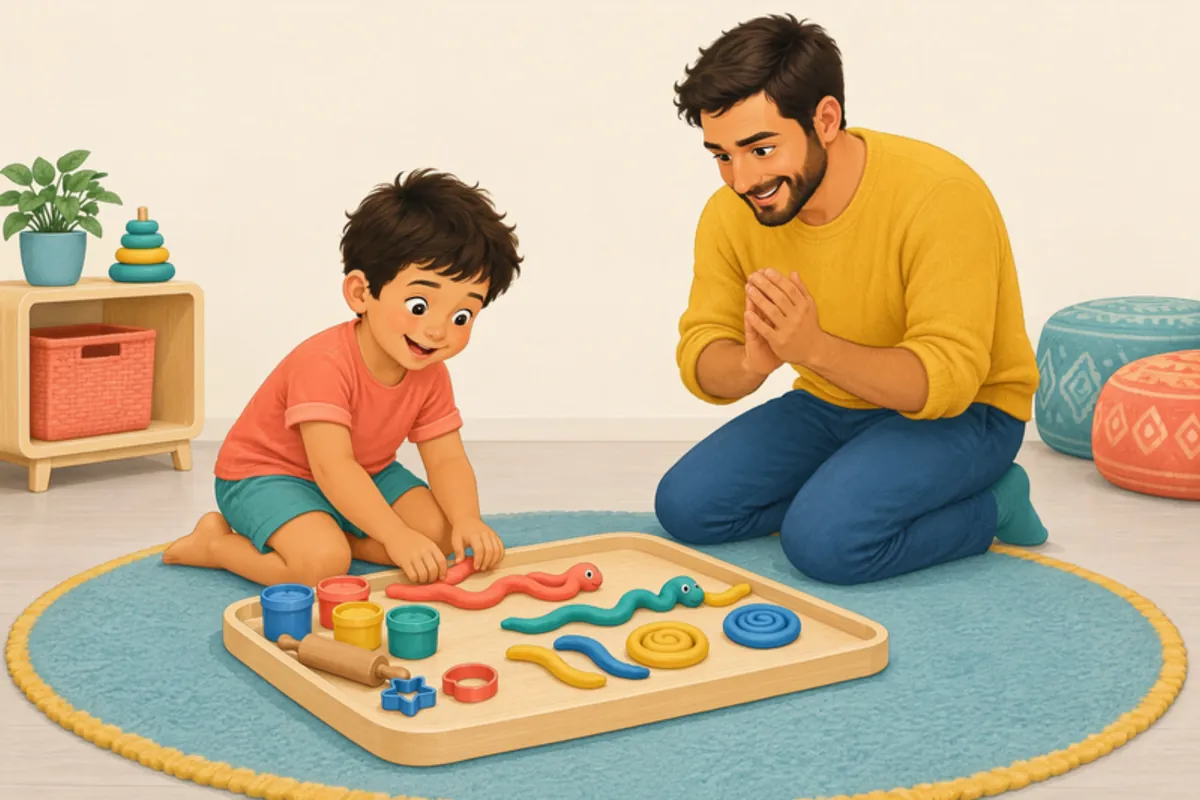
- Play-dough letters. Roll long “snakes” and bend them into letters.
- Letter hunt. Hide three letter cards in the room. “Can you find siin?”
- Sound basket. Put three objects in a basket. “Which one starts with b? Batta!”
- Letter of the day. Stick today’s letter on the fridge. Everyone looks for words that start with it.
- Paint with water. A big brush, a cup of water and the balcony wall or floor. The letters dry and disappear like magic. Stay beside your child on a balcony.
- Back writing. Trace a letter on your child’s back with your finger. Can they guess it? Then swap.
- Jump to the letter. Write letters on sheets of paper on the floor. Call a sound and your child jumps to it.
Letters that look alike
Many Arabic letters are families that share one shape and differ only by their dots, such as baa, taa and thaa. Teach the shape as a “boat”, then play with the dots: one dot below for baa, two above for taa, three above for thaa. Stickers or big paper circles make great dots. Keep small pieces away from children under 3. Introduce look-alike letters a few days apart, not on the same day.
4 common mistakes to avoid
- Lessons that are too long. Stop while your child is still enjoying it.
- Correcting every mistake. Show the right shape again and move on. Praise the effort.
- Paper and pencil too early. Small hands need play first: dough, sand, big brushes.
- Comparing children. Every child learns letters at their own pace, and all of them get there.
Questions parents ask
At what age should a child learn the Arabic alphabet?
Many children start showing interest in letters between 3 and 4 and learn them gradually up to age 6. There is no need to hurry: talking, singing and reading together are the best preparation.
Which Arabic letters should I teach first?
Start with the letters of your child’s name, because they matter to your child. Then add a few letters at a time, and introduce letters that look alike on different days.
How many letters should I teach each week?
Two or three new letters a week is enough for most young children, with a quick, playful review of the letters they already know.
How can I teach Arabic letters if my own Arabic is weak?
Learn alongside your child. Use songs, storybooks read aloud and calm learning apps for the correct sounds, and let grandparents or Arabic-speaking relatives join in by video call.
This article gives general information for families. It does not replace advice from your child’s doctor or another specialist who knows your child.


